Herb cabinet
Alfalfa
Medicago sativa. A symbolic and practical entry, not a medical monograph.
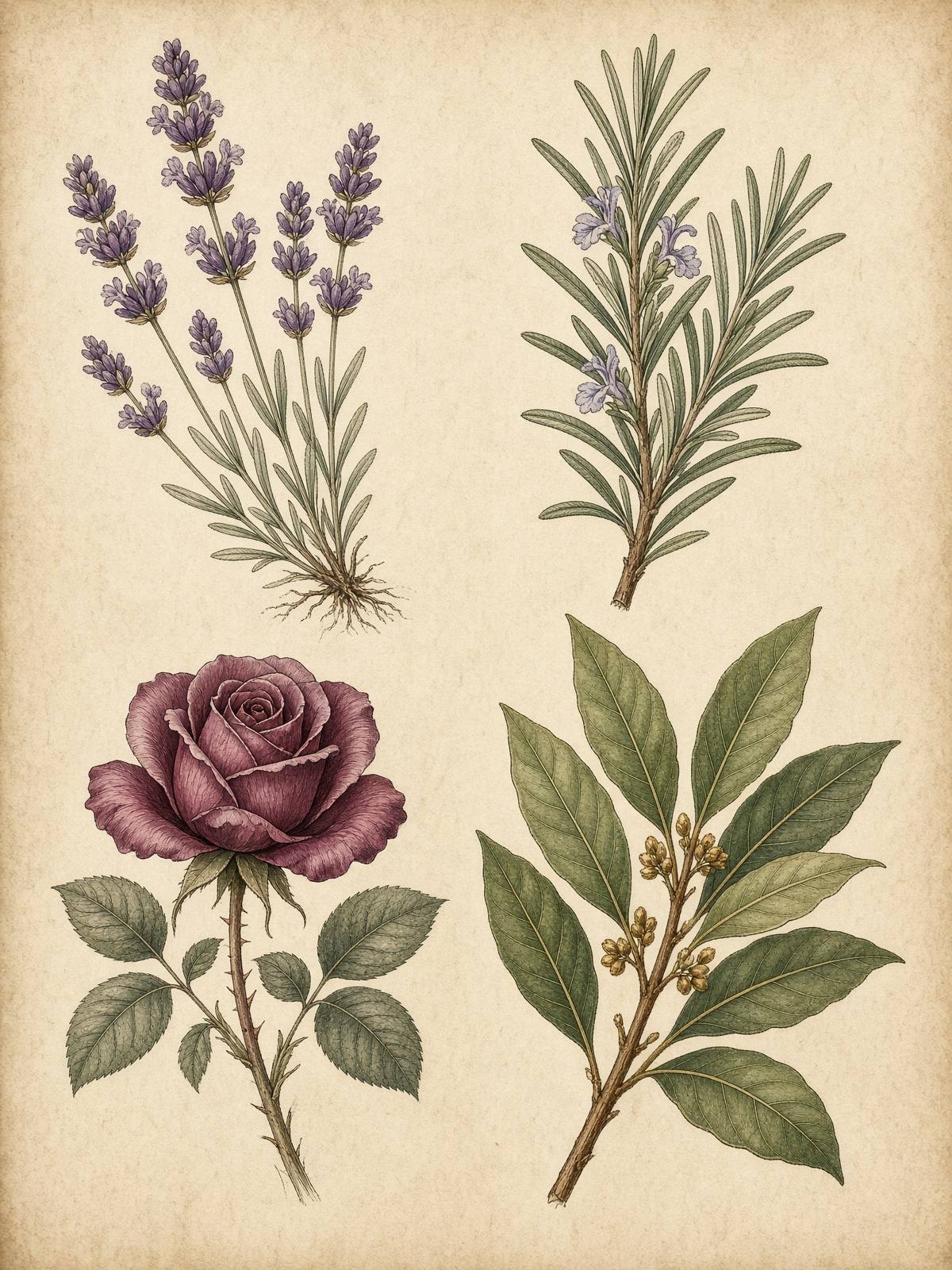
Alfalfa is a deep-rooted perennial legume with trifoliate leaves, each leaflet toothed at the tip, and dense heads of violet to blue pea-flowers that dry to sickle-shaped seed pods. In the field it reads as a purple-green haze rather than a single dramatic bloom. Sprouts sold for eating are pale threads with tiny green cotyledons and are the same species at a different age. This description is not a sufficient identification key.
Names
| Common name | Alfalfa |
| Botanical name | Medicago sativa |
| Family | Fabaceae |
| Also called | lucerne, purple medic, buffalo herb |
| Uncertainty | None especially noted beyond ordinary species variation. |
| Habitat and source | It is an Old World fodder crop, likely shaped in the Iranian plateau and now grown in temperate fields worldwide wherever drainage is decent. Commercial leaf and sprout come from farms, not from hedgerow foraging. |
Symbolic correspondences
| Tag | Attribution |
|---|---|
| Element | Earth |
| Planet | Jupiter |
| Themes | slow increase · honest fodder · deep root · the tended field |
Folklore and history
Alfalfa's paper trail is agricultural. The English word arrives through Spanish alfalfa from Arabic al-fasfasa, fodder of the best sort, and the plant was carried from western Asia across the Mediterranean and, from the sixteenth century onward, into the Americas as livestock feed. It is a nitrogen-fixer, a hay crop, and only later a salad sprout. Maud Grieve, in A Modern Herbal (1931), discusses it as a nutritious plant rather than a charm. Kew and other botanical authorities keep Medicago sativa distinct from the clovers (Trifolium) and from sweet clover (Melilotus), a different genus with a different risk if the hay molds.
Prosperity lists that name alfalfa as a money herb are a modern spiritual attribution, especially in twentieth-century American folk-magic catalogues. They are not a recovered ancient priesthood, and they are not a hidden queer rite. The Wilde Altar treats that attribution as metaphor only: increase that depends on water, soil, and somebody's labor. The plant does not pay a bill, reverse an illness, or outvote a landlord. Jupiter, in the old astrological herbals, was the planet of plenty; we borrow the poetry of plenty and leave the medical theory in the seventeenth century where it belongs.
Safety
Ritual applications
- A bowl of fresh sprouts as a table emblem of work that compounds slowly
- A dried sprig tucked into a ledger or budget notebook, then composted when the month ends
- A spoken thanks over a meal that already includes alfalfa, with no charm added to the food
An original working
The Ledger of Small Green Increase
To pair a symbol of slow growth with one real financial or household task you can finish this week.
Timing: Any quiet hour, especially a morning you already meant to open the bills
- Material: A small pinch of fresh alfalfa sprouts from a grocer, or dried alfalfa leaf from a spice seller if sprouts are unavailable
- Material: A shallow dish
- Material: A notebook and a pen
- Material: A glass of drinking water
- Material: A compost pail
- 1Wash your hands and set the dish, the notebook, and the water on a clear table.
- 2Put the sprouts or dried leaf in the dish. Do not light them.
- 3Write one concrete increase you want, and under it the single ordinary action that would move it, such as a phone call, a transfer, or an hour of work.
- 4Read the action aloud once, then drink the water as water, not as a potion.
- 5Eat the sprouts as food if they are fresh and you want them, or tip them into the compost. If you used dried leaf, compost that too.
- 6Close the notebook on the written action and leave it where you will see it tomorrow.
Little green ledger, I do not ask you to mint money. I ask for a steady hand with the work already mine. What grows here grows because it is tended. So will this.
Close. Compost the plant matter. Wash the dish. Do not keep rotting sprouts on an altar. The working ends when the notebook is shut; nothing has been guaranteed.
A practical action. Do the one action you wrote, today or on the day you named, and record what actually happened.
Substitutions
- A pinch of culinary clover blossom if alfalfa cannot be had, with clover's own cautions
- A handful of garden pea shoots, as another legume food, used the same way and then eaten or composted
Growing and sourcing
Alfalfa wants full sun and deep, well-drained soil; it is a serious forage crop more than a windowsill pet, though a pot of sprouts can be grown as food. Do not dump seed into wild grassland, where a fodder plant can elbow native flora.
Beginner questions
- Does alfalfa magically clear debt? No. It is a symbol of tended growth; the payment still has to be made in ordinary money.
- Can I take alfalfa supplements for lupus or any illness? No. Supplemental alfalfa is a poor idea in autoimmune disease and is not a treatment.
- Are sprouts the same as seeds? No. Grocery sprouts are a food; seeds and pills are a different, more concentrated product and are not part of this working.